Any good Garth Ennis tale (and by extension that includes artist Steve Dillon) will involve topics like honor, truth and justice ... along with a healthy dose of bullets to the head and jaws blown off. Such is the nature of the 2003 Punisher story arc called "Brotherhood."
Originally presented in the Marvel Knights imprint of The Punisher, the three issue story is about cops gone bad, coke deals gone bad, priests gone bad, domestic violence (already bad) and how the world views someone based on the actions of a few bad apples. Frank Castle (Punisher) has vowed to never cross the line and kill a cop, but the two cops he runs into push him to the very edge. Their addictions have mired them in a world of wife beating, gambling and stealing evidence. When Castle enters the picture, the cops' world is already spiraling out of control and people are dying.
Before this was a Max title, The Punisher had to watch the language and nudity (nobody really worried about the violence), so this isn't as nasty as it could be. It still makes its point without the use of words you'd normally find in this sort of tale. That is the mark of a good group of storytellers, which as we know from Preacher, is exactly what Ennis and Dillon are.
Marvel's 2003 universe is far different from the one of the past few years, and this was its darkest title at the time. Oddly enough, it was also its most realistic. If you take the Punisher out of the equation, most of what the creators did was from real life, whether it be drug deals or IRA terrorism. It was a far cry from the X-Men or Spider-Man, and for that I appreciated it.
"Brotherhood" will never be considered a classic tale. With Ennis and Dillon, everything they do is grand, but to standout at this point it really needs to be spectacular. It will, however, be a prime example of a strong tale that will never age. Someone reading this ten years from now will recognize the themes and issues at hand, and they will in no way be alien to the reader. Try saying that about some of the other stories we've witnessed as of late. You can't. And three issues was all it took. Concise, but with about three times the dialogue of your average current comic, and well-paced. It may not be a classic, but it should be studied.
Showing posts with label Steve Dillon. Show all posts
Tuesday, October 19, 2010
Saturday, June 6, 2009
Thoughts On The Punisher
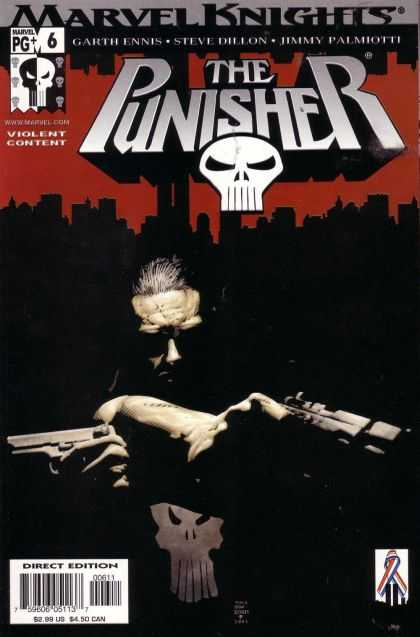
9/11. New York. Punisher's stomping ground. Under the Marvel Knights imprint, The Punisher issue six was to see light around two months after 9/11, a fact noted by the comic's writer, Garth Ennis. Ennis and artist Steve Dillon (who also teamed up on the incredible Preacher series, one of the best stories of all time) made this issue an examination of the Big Apple's spirit, and since it was written well before 9/11, it does not focus on that event.
In this issue the Punisher is hunting a man he knows, a man he served with in Vietnam, a man who has killed his own family. Punisher wants him before the cops get him, and we all know why. Throughout this, though, the character of the city, its nature, its mores are ruminated on. It seems like the City That Never Sleeps is also the City That Doesn't Care, a fact brought home in the issue's final panel. Frank Castle, the Punisher, as we expect, gets his guy. That was never in doubt. What was in doubt was his reaction to it and his reasoning beyond the norm. Yeah, Punisher kills the guilty, but here he shows heart (though some may say I'm being morbid about that).
Marvel Knights stories were supposed to be grittier than the standard Marvel fare, and they were for the most part. This issue is no different. What is different that the people involved in it decided that since 9/11 was still in everyone's minds (and would not be gone for some time), they would have to comment on it on the text page. They realize they do a comic filled with over-the-top violence, and now America has experienced that up close. What do you do? Apologize for it? Brush the comic off as mere entertainment? Ignore it? No. You do what they did here. You write about it. You don't apologize for a violent comic book (the comic book did not cause 9/11 or even the mentality behind it). As artists, which is what comic creators are, their job is to create, comment, and examine. Ennis and Dillon do that here. What they didn't know when they created the story is that their take on New York would somehow become even more meaningful (or damning, depending on your worldview) in light of the terrorist attacks.
The Punisher has never been known as a subtle character, this tale being an exception. Those who haven't ever read his adventures, however, probably will never understand his appeal. His fans know that he is justice without apology, swift and sure. It is something a lot of people wish would happen more in this world. They also understand why it can't. This tale, which opens with a tragic homeless man begging for money as people do their best to pretend he doesn't exist, shows why Punisher fans are right in claiming him as their own. Those who don't get it, won't have their minds changed by it, though. There is nothing in it that will turn on that bulb in their heads. The end, however meaningful it is, will be seen as nothing but violence.
That, too, mirrors the outcome of 9/11, in a way that could have never been predicted. Violence meets violence. One act not really understood at anything other than a base level. The other done for what is looked at as humane reasons. Terrorist attack. War. Unlike the end of this tale, however, the war that ensued has not reached any kind of emotional conclusion. There hasn't been a moment that brings the story full circle. The war hasn't end, but the tale has. My guess is that by the time this war does end, the conclusion of this Punisher story will be far more heartfelt and honest than anything that could possibly transpire overseas.
Subscribe to:
Posts (Atom)